Monday, March 26, 2007

Curse of the Narrows: The Halifax Explosion 1917 - Laura M. MacDonald

The Basics: Curse of the Narrows: The Halifax Explosion 1917, Laura M. MacDonald, 2005, 282 pages

How I found it: This book is in every tourist shop around town and is prominently displayed in every book store. Having lived in Halifax for over a year, I figured I should inform myself.

What's it about?: A comprehensive history of the events leading up, during, and after the Halifax Explosion in 1917. It is presented using the narratives of many different people, from school children, to sailors, to doctors and volunteers.

Did I like it?: This book was exceptionally well researched and well written. It presented the issue from many different viewpoints without playing the blame-game about who caused the accident. I had already read a fictionalized account of the explosion, however, Hugh McLennan's Barometer Rising. The books are quite similar, exception that McLennan's novel follows a few people and involes a love story, while MacDonald's follows many and does not too personal. MacDonald's is obviously more factual, but McLennan's did not seem very inaccurate in comparison.

Will you like it?: If you've already read McLennan's book, I would skip this one, unless you are dying to know all the gory little details. If you are looking for a strictly factual account of the Halifax explosion, pick up MacDonald's book. It's very education without ever being boring. Either, way pick up one of them; they're both great.

But don't take my word for it: The usual collection of blurbs from amazon.ca, a review from blogcritic.org, one from VariFrank that points out the potential for modern terrorism in a situation like the Halifax Explosion, and a review from rabble.ca.

Saturday, March 17, 2007

The Song of Kahunsha - Anosh Irani

The Basics: The Song of Kahunsha, Anosh Irani, 2006, 308 pages, hardcover, nominated for Canada Reads 2007

How I found it: I decided to read all of the Canada Reads books this year and this is the final one I read.

What's it about: This is Oliver Twist in Bombay. Ten year old Chamdi learns that his orphanage is about to close so he runs away and begins living on the streets of Bombay with two other children. He quickly learns the rules of the street. He becomes involved in a shady life of crime and soon looses his innocence. The book takes place on Chamdi's first 3 days on the streets.

Did I like it?: This is one of the more depressing books I have read in a while. I was aware of the extreme poverty among street people in South Asia, but this brought my awareness to a whole new level... a level that I perhaps didn't want to reach. The book is told from Chamdi's perspective and at times I was annoyed with is naivete and his constantly climbing onto the moral high horse in such a self-righteous way. Chamdi is meant to be a courageous character, but I found him a bit smug in his bravery and morals at times. Overall, it was an interesting book, but I can't say I enjoyed it that much. I also took issue with it being involved in Canada Reads. The author is now a Canadian, but there is nothing particularly Canadian about the book. I don't think it should have been excluded, I just think there may have been better choices that better reflected Canada. A book doesn't have to take place in Canada to feel Canadian... but to be Canadian I don't think it should feel 100% Indian.

Will you like it?: Do you like The Kite Runner, books by Wally Lamb, everything from Oprah's book club, and being profoundly depressed while reading a book? If so, this is a book for you. If not, you might want to skip it.

But don't take my word for it: The usual positive blurbs from Amazon.ca, a positive reader review, a review from journalist Joe Wiebe's blog, one from the London Free Press, another from Blog Critics Magazine, one from the inaugural issue of Desi Lit, and a link to the book's page on this year's Canada Reads.

Wednesday, March 14, 2007

Stanley Park - Timothy Taylor

The Basics: Stanley Park, Timothy Taylor, 2001, 423 pages, hard cover, nominated for Canada Reads 2007

How I found it: I had read this book before (recommended by Jess I think) but I read it again since I wanted to read all of the Canada Reads books this year and evaluate them for myself.

What's it about?: A struggling youngish chef tries to manage his doomed restaurant, a new girlfriend, and a complicated relationship with his father. Jeremy, the protagonist, has to make tough decisions about whether to sell out or not, whether to tell his girlfriend, his father, and his sous chef about his financial difficulties and what to do about his father's increasingly participatory forms of anthropological study. Jeremy's dad, "The Professor" is studying homeless people living in Vancouver's Stanley Park, but he has begun living among them and losing touch with academia and reality.

Did I like it?: I remember enjoying this book a bit more the first time. This time around it seemed a little pulpy. I think part of the problem is that I didn't identify with Chef Jeremy. He kept all of his problems bottled up inside and didn't tell anyone about them. While that makes a great premise for a book (see Little White Lies), it doesn't make for a likable character in my opinion. I didn't think the character development was very good since I was left wondering why Jeremy had made some of the decisions he did. All in all, an interesting book, but definitely not deserving of the Canada Reads title.

Will you like it?: Despite my criticisms of this book, it is a good one and is worth reading. I just don't think it is spectacular enough to be the one book that Canadians should read. It's a good story and if love food and Vancouver, you will appreciate the small roles both of those factors play.

But don't take my word for it: The usual collection of positive blurbs from Amazon.ca, lots of glowing reader reviews, a review from Book Reporter, one from the foodie blog VanEats, an interesting take from the Book Mine Set blog, and an interview with the author from CBC's Words at Large.

Saturday, March 10, 2007

Waiting for the Macaws and Other Stories from the Age of Extinctions - Terry Glavin

The Basics: Waiting for the Macaws and Other Stories from the Age of Extinctions, Terry Glavin, 2006, 318 pages, hardcover

How I found it: I believe this book was recommended to me by Amazon.ca's recommendations service. Or I could have seen it on either the Tyee or the Canadian Geographic book reviews linked below. Either way, it has been on my list of books to read for about a year but I never really got around to it.

What's it about: Glavin is a conservationist and was an early member of Greenpeace. In this book, he travels around the world visiting the habitats of some of the world's extinct or soon to be extinct species to learn about them and the greater picture of increasing global extinctions. Despite his extremist past, Glavin is quite moderate in his attitude. He does really come to any conclusions about what can be done to save any of these animals and seems to have conflicted feelings on the helpfulness of zoos, breeding programs, etc.

Did I like it?: I didn't mind this book, but it took me quite a long time to get through it. Some of the sections were particularly interesting, especially the final section on the Naga people and their unique agricultural practices in India's Eastern Himalayas. Other sections seemed disjointed and convoluted and I wasn't sure how they tied together. Overall, it was an interesting read, but not a terribly good one.

Will you like it?: This is one of those "the sky is falling" environmentalist books that has become so popular lately. However, it is presented in a way that tells the stories behind the statistics, shows us the people, plants and animals that are threatened. That makes the book worthwhile and lends the cause a bit more credence since we can more clearly see the effect we have on our world.

But don't take my word for it: The usual collection of review quotes and descriptions from Amazon.ca, a review from the Globe and Mail, one from Vancouver Review, another from The Tyee, one from Canadian Geographic, and finally, the author's blog.

Sunday, February 25, 2007

Lullabies for Little Criminals - Heather O'Neill

The Basics: Lullabies for Little Criminals, Heather O'Neill, 2006, 330 pages, paperback, nominated for CBC's Canada reads 2007

How I found it: I am slowly working my way through the Canada Reads 2007 nominees list.

What's it about?: This is a coming of age novel. The protagonist, who's given name is actually Baby, has to grow up fairly quickly on the streets of Montreal. She lives in poverty with her junkie father and struggles to figure out what it means to not to a child anymore, to find friends, and to tell right from wrong. The book is written from her perspective at her twelve-year-old reading level, so at my library it was marked as a young adult book. However, I think that most kids reading this book would be quite scared.

Did I like it?: I liked this book on some levels because it opened my eyes to the situations that many children in poverty face. Growing up in a stable middle class home it is easy to say that people who area addicted to drugs, living on the street, and turning tricks are a lower class of people. Canadians love to distance themselves from our urban poor. O'Neill's novel humanizes this group and helps the reader to understand why poverty is cyclical. In a better off home, a tween child who is as unhappy as Baby would be sent to counselling, or encouraged to spend time with family. In Baby's world, when she is unhappy her solutions are drugs, sex and violence. I thought this would be something I wouldn't relate to, but somehow, O'Neill made me understand why Baby did the things she did.

Will you like it?: This book is probably nominated for Canada Reads to make us think about the situation of impoverished Canadians, and the book certainly does do that. However, it is a good read on its own. I didn't love it, and I think some of the other choices for Canada Reads are more deserving. If you are a parent, I think you might enjoy reading this book because (I assume) it will make you feel like you are doing a great job in comparison to the parents in this book. And if you aren't a parent, you can at least read this book and feel lucky to have escaped a life like Baby's.

But don't take my word for it: the usual collection of literary reviews and info from Amazon, a glowing reader review, a review from KGB Bar's online lit magazine, one from Dose Magazine (not to be confused with Dose the newspaper apparently), one from Toronto's Now Magazine, and an interview with the author.

Tuesday, February 20, 2007

Moral Disorder: Margaret Atwood

The Basics: Moral Disorder, Margaret Atwood, 2006, 225 pages, hard cover

How I found it: This is Margaret Atwood's latest work, so I read it as soon as I could get it from the library. If it's by Margaret Atwood and it's fiction, I am required to read it.

What's it about: This is the latest of Atwood's short story collections. All the stories in this book are about the same woman, similar to the way David Bezmozgis structured Natasha. The stories are sometimes told in the first person and sometimes in the third person and range in the period in which they take place. This is the life of one woman from early memories to old age and much in between (but not told in that order).

Did I like it?: Like much of Atwood's work, I loved it. I flew through this book in only a few days. As usual I found I related easily to the protagonist and was interested in her life and the lives of the people around her. Atwood's prose has not diminished as she ages either, and as expected, she is brilliant. The only small quibble I have is that Atwood draws on the same scenarios again and again - the scenario of her childhood: the summers spent in a backwoods cabin while her father studies insects, the often distant older brother, the feelings of isolation and not relating to the city children each fall. We can't rehash the plot points of Surfacing, etc. repeated, although with different characters. It gets a bit old. That's a minor point though - I can't think of anything else to complain about.

Will you like it?: As with some of Atwood's book, this one takes being a woman to fully understand it. It's fairly accessible to the casual reader - it has none of the poetic or academic devices found in some of her books. It is very straight forward, and well written. A good one for book clubs.

But don't take my word for it: The usual round-up from Amazon.ca (including one disgruntled reader review and what looks like a literary review of the audiobook version), one from the Guardian, one from the London Times, and one from the Washington Post.

Friday, February 16, 2007

Treading Water - Anne DeGrace

The Basics: Treading Water, Anne DeGrace, 2005, 302 pages, paperback. This is the author's first novel.

How I found it: Greg gave me this book for Christmas. He said he picked it because it was written by a Canadian female author so he knew I would like it. Little did he know that was filled with Mennonites!

What's it about?: This novel is about a small town in the mountains of BC, only accessible by water. The book traces the life of the town, and the town becomes a character in of itself, helped along by the various people who live there through the years. The book is told in a series of vignettes, each corresponding with a year. We proceed chronologically through these vignettes, each told by a different character, to watch the town come of age, mature, and subside into old age and decline.

Did I like it?: I loved this book. It was beautifully written and by the end I wanted to visit the town, even though it is fictional. The town took on a life of its own for me. Even though the characters who lived there through the generations had lives of their own, which were interesting, the way the townspeople interacted and shaped the town was much more compelling. The book begins in 1904 and ends in 1967; the lifetime of a person is the lifetime of the town.

Will you like it?: This is a great book, and a good one for book clubs. I even cried at the end! DeGrace is a talented writer and I look forward to seeing more of her work. In the meantime, go out and read this book. I really enjoyed reading it and you probably will too.

But don't take my word for it: The usual literary reviews and reader reviews from Amazon.ca, info about the book from BC Book World, and a link to a CBC radio interview with the author (scroll down) were all I could find.

Saturday, February 10, 2007

Cabin at Singing River: Building a Home in the Wilderness - Chris Czajkowski

The Basics: Cabin at Singing River: Building a Home in the Wilderness, Chris Czajkowski, 1991, 149 pages, paperback.

How I found it: My dad has read most of Czajkowski's books (along with most of the non-fiction section of his local public library) and recommended that I read something of hers. I chose to begin with her first book.

What's it about?: Czajkowski was born in the UK but apparently has lived all over the world. She moved to Canada in the late '80s, settling in Salmon Arm, BC, but found city life too hectic. If you've ever been to Salmon Arm, you might find this a bit laughable. Nevertheless, Czajkowski ended up in the Chilcotin area of BC, south of Tweedsmuir Provincial Park in her search for solitude. Some friends of hers had an old homestead that could only be reached by a float plane or a 2 day hike in from the road. They agree to let her erect a cabin on their property. This book details her struggle to build the log cabin herself, and to make her home in the wilderness. Oh, and did I mention she had never used a chain saw before?

Did I like it?: While Czajkowski is definitely an odd character, I definitely related to her in a lot of ways. The idea of setting out nearly alone in the bush, building your own home, and being self-reliant is very appealing in a lot of ways. The fact that a woman with no carpentry experience accomplished this is admirable as well. I would love to be able to walk out my front door and do a multi-day off-trail hike. Czajkowski is not an exceptionally gifted writer, but her succinct and personal style, coupled with her interesting subject matter make for a good read.

Will you like it?: Many of Peter Gzowski's CBC listeners did. Czajkowski wrote periodic letters to his morning radio program, and reading them became a regular feature on his show. Many Canadians were interested to hear the story of an independent woman living alone in the wilderness. She is the Susanna Moodie of our time. Of course, if you hate the outdoors, you might not like the book, but that will be your loss.

But don't take my word for it: A collection of reviews on Amazon.ca, a bio on the author from BC Bookworld, a review from the blog Classical Bookworm (complete with a reply from the author in the comments section), and finally the author's web page with info about her books, as well as the guiding operation she runs out of one of her newer wilderness cabins.

Friday, February 09, 2007

Middlesex - Jeffrey Eugenides

The Basics: Middlesex, Jeffrey Eugenides, 2002, 529 pages, paperback, winner of the of Pulitzer Prize for fiction in 2003.

How I found it: My youngest sister gave it to my for Christmas. Apparently she quite liked it.

What's it about?: A story of three generations of a Greek immigrant family in the American Mid-West, the youngest member of which happens to be a hermaphrodite (hence the title). Cal (or Callie) the narrator lets the viewer in on his secret on the very first page, but we have to wait until about 2/3 of the way in to find out the details of how he discovered he was a hermaphrodite and what that has meant for his life. Cal tells the story as if he is speaking to the reader in his free time. He takes us through the lives of his grandparents and his parents, and finally his own life up to the present.

Did I like it?: I couldn't put this one down. Eugenides' style of writing made me believe that I was reading an autobiography, not a work of fiction. Even if the author were to have left out Cal's portion of the story, the section on his grandparent's flight from Greece to America and their struggle to establish themselves in their new country would be a good book all by itself. The only thing I didn't like about this book was that it is a little long. At over 500 pages, I felt it would have been better off as two books, one a sequel (or a prequel) to the other.

Would you like it?: I highly recommend this book. It's a great story about an immigrant family and their family dynamic. In addition, this is also a coming of age novel (although the person coming of age happens to be a hermaphrodite. I didn't know anything at all about intersexed people, so this book was rather educational in that regard.

But don't take my word for it: A review from Salon.com, one from CNN's archives, the usual collection of reviews from Amazon.ca, some reader reviews, a review from New York Magazine, and finally one from The Guardian.

Tuesday, January 30, 2007

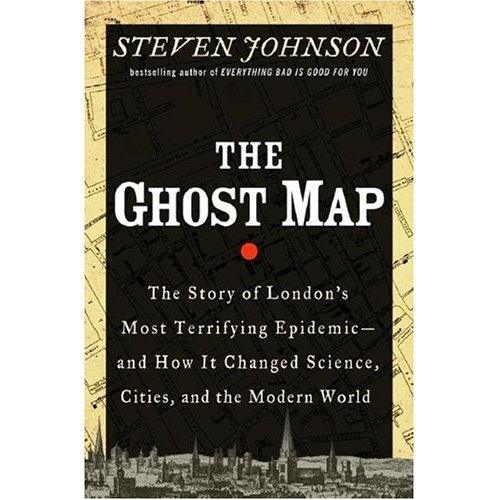
The Ghost Map: The Story of London's Most Terrifying Epidemic and How it Changed Science, Cities and the Modern World - Steven Johnson

The Basics: The Ghost Map - The Story of London's Most Terrifying Epidemic and How it Changed Science, Cities and the Modern World, Steven Johnson, 2006, 299 pages, hardcover

How I found it: Greg gave me this book for Christmas, likely because I am a big cartography fan. In fact, this map comes up in almost every single cartography text ever written.

What's it about?: An explanation of the history behind the ghost map and how it helped solve a cholera epidemic in 1850s London. Johnson goes into the involvement of Dr. John Snow, who was investigating the disease, and Reverend Henry Whitehead, the head of the parish affected by the outbreak. He also explores the broader social context of city planning and waste disposal that contributed to the epidemic.

Did I like it?: This book is sort of a detective story that is solved by making a map, so I liked that aspect of it. But I'm not an epidemiologist so a lot of the stuff that Johnson discusses was not that interesting to me. In particular, Johnson spends the whole closing section of the book comparing the cholera epidemic to the contemporary threat of terrorism and bio-terrorism, and I found that portion a little irrelevant. Johnson's style of writing is fairly informative, but at times I found it a little dry. The endless discussions of sewer construction, etc. were a bit much. I think this book could have been 50 to 100 pages shorter.

Will you like it?: If you've ever wondered about the origins of the 'Ghost Map' and want the full story, this is a good read. I suppose if you are into epidemiology you might like it as well. Otherwise, it's not that exciting.

But don't take my word for it: The usual collection of reviews and book info from Amazon.ca, a reader review from Amazon, one from abstractdynamics.org, another from kottke.org, and one from treehugger.