Showing posts with label coming of age. Show all posts

Wednesday, May 09, 2007

Bloodletting and Miraculous Cures - Vincent Lam

The Basics: Bloodletting and Miraculous Cures, Vincent Lam, 2005, 353 pages, paperback, winner of the Giller prize.

How I found it: My mom read it for her book club and when I arrived to stay with her I found it waiting on my bedside table.

What's it about?: This is a collection of short stories about becoming and being a doctor. It is also about relationships evolving over time, coming of age, and related themes. Lam also tackles the stereotyped issue of Asian immigrant parents and their expectations for their children and the SARS epidemic in Toronto.

Did I like it?: Despite the gross-out factor (for me) of all the medical stuff, I really liked this book. The short stories all involve the same set of characters, and over time, I came to identify with most of them. Since all of the stories were interrelated, the book did read a bit like a novel, and as a result, I was eager to see what happened to each of the characters so I read it quite fast.

Will you like it?: This book has had a lot of critical acclaim, and rightly so. It is well written, has compelling stories and characters, and provides insight into something most of us don't know too much about - what it is really like to be a doctor. I was surprised with how much I liked it, as I had thought it wouldn't be my 'thing'.

But don't take my word for it: The usual collection of professional reviews and reader reviews from Amazon, one from Toronto's NOW Magazine, a review from the online January Magazine, one from the blog The Library Ladder, and the author's official website.

Sunday, April 29, 2007

The Birth House - Ami McKay

The Basics: The Birth House, Ami McKay, 2006, 368 pages, paperback

How I found it: My mom read this for her book club and recommended it to me because of the Nova Scotia setting.

What's it about?: The book follows the life of Dora Rare, a misfit a small rural Nova Scotia town at the dawn of WWI. Dora is apprenticed to the local midwife, despite the fact that midwifery has fallen out of favour with the men of the community who believe they should use the modern doctors available in the nearest city. Dora perseveres and manages to stand up for women's rights in a time when it was not common to do so. The book follows her from her adolescence to her middle age, and involves her friends, marriage, and children.

Did I like it?: I liked this book, perhaps even more so since I have actually been to Scot's Bay, where the book is set (although I was there really briefly - that is where the hike to Cape Split begins). I identified with Dora and thought she was a strong and likable character. The book takes a strong stance on the promotion of midwifery, which is fairly unknown to most these days. The traditional knowledge involved in being a midwife was interesting, but I felt it sometimes took up a bit too much of the book.

Will you like it?: Unfortunately, I'll say it again - this is primarily a women's book and is good for book clubs. The midwife stuff is TMI at times, but otherwise I really liked the story and I think most people would as well.

But don't take my word for it: the usual blurbs and reader reviews from Amazon, the book's official website, one from Blogher.org, another from LiteraryMama.com, one from Toronto's Now Magazine, and finally one from the Book-a-rama blog.

Saturday, April 28, 2007

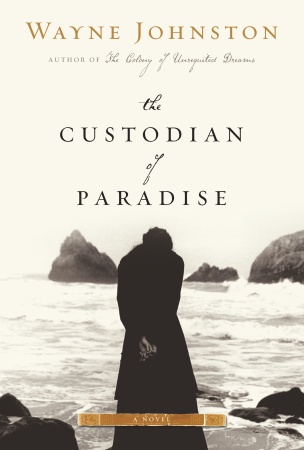
The Custodian of Paradise - Wayne Johnston

The Basics: The Custodian of Paradise, Wayne Johnston, 2006, 528 pages, hardcover.

How I found it: This book got a fair amount of press when it was released last year and since I have enjoyed some of Johnston's other work, I put my name down on the waiting list at the library.

What's it about?: This is the companion book to Johnston's The Colony of Unrequited Dreams, a fictionalized biography of Joey Smallwood, Newfoundland's first premier. In that book Joey Smallwood's sometime friend and some time nemesis, Fielding, plays a fairly important role at times. This book is Fielding's story. Sheilagh Fielding is a 6'3" misfit, unsure of her heritage, and unable to live according to society's conventions. She has an acid wit and is known about St. John's for it, along with her stature and eccentricity. The book tells the story of her life and focuses on her relationship with a mysterious never seen guardian who will only identify himself as "Your Provider".

Did I like it?: I expected to really like it, but somehow was a bit disappointed. I think perhaps it was because of the length of the book... after awhile it began to drag. I enjoyed Fielding's early years, but as she became more and more obsessed with her provider, I began to lose interest. I found the storyline surrounding her provider to be a little contrived and really beyond belief. I also thought that for a book told in the first person, we didn't really learn that much about Fielding... I didn't feel as if I knew her very well after reading it. She is a very difficult character to relate to, perhaps because she is such a charicature in a lot of ways.

Will you like it?: This is an interesting read, as is usual for a Wayne Johnston book. It is also a unique look at Newfoundland when it was still a colony. However, this wasn't nearly as good as Colony of Unrequited Dreams, or even the Navigator of New York. It has been awhile since I read Colony and I think perhaps this book would be better if read directly after reading Colony.

But don't take my word for it: The usual collection of blurbs and reader reviews from amazon, a review from topix.net, one from the Tyee, one from the Chicago Sun-Times, one from the Perceptive Travel Blog, and the author's website.

Tuesday, April 03, 2007

The Time Traveler's Wife - Audrey Niffenegger

The Basics: The Time Traveler's Wife, Audrey Niffenegger, 2003, 518 pages, paperback.

How I found it: My youngest sister called me on her cellphone a few days before Christmas to ask if I had read The Time Traveler's Wife. When I said I hadn't I assumed I would be receiving it as a her Christmas gift to me in a few days. Instead, she got me the awesome Middlesex. When I was using a Christmas gift card (from my mom) at Chapters I saw this book and since my sister had effectively recommended it, I picked it up.

What's it about?: Henry is a time traveler. He has a disorder that causes him to travel to other times when he gets stressed out, scared, or has another trigger for his problem. It is sort of like epilepsy, only with time travelling instead of seizures. Clare is his wife, except that she meets him when she is 6 years old since he time travels into her childhood to meet her. She knows him her whole life. The books is about the unfolding of their life together in their strange mixed up chronology. It is a love story and it is also about the dangers of Henry's disorder and his attempts to cure it.

Did I like it?: I LOVED this book. I can't believe this is Niffenegger's first novel. The writing is not exceptional, but it is very polished with well developed characters and a seamless plot. I found the book a bit confusing at first while I wrapped my head around the whole time-travelling thing, but I soon got into it. I couldn't put this book down - I wanted to see how it ended, but at the same time I didn't want it to end. It was incredibly romantic, and therefore, incredibly sad at times. I have to say I was hesitant to read this book since it is so popular, but this time, the public actually made a good choice.

Will you like it?: If you have a romantic bone in your body you should read this book. It's a great story, even without the romantic aspect. And don't be put off by the time-travelling part - this book is about as far away from science fiction as you can get. It's a neat idea for a book that is well executed here.

But don't take my word for it: A collection of reviews from Amazon.ca, this is a popular book so here is a collection of 109 reader reviews, a review from ReviewsofBooks.com, one from the Guardian, another from January Magazine, one from curledup.com, one from the Medical Humanities blog, one from a guy named Steve's blog (guys like "good old sentimental weepies" too), and the imdb page for the movie, coming out in 2008 and potentially starring Rachel McAdams.

Saturday, March 17, 2007

The Song of Kahunsha - Anosh Irani

The Basics: The Song of Kahunsha, Anosh Irani, 2006, 308 pages, hardcover, nominated for Canada Reads 2007

How I found it: I decided to read all of the Canada Reads books this year and this is the final one I read.

What's it about: This is Oliver Twist in Bombay. Ten year old Chamdi learns that his orphanage is about to close so he runs away and begins living on the streets of Bombay with two other children. He quickly learns the rules of the street. He becomes involved in a shady life of crime and soon looses his innocence. The book takes place on Chamdi's first 3 days on the streets.

Did I like it?: This is one of the more depressing books I have read in a while. I was aware of the extreme poverty among street people in South Asia, but this brought my awareness to a whole new level... a level that I perhaps didn't want to reach. The book is told from Chamdi's perspective and at times I was annoyed with is naivete and his constantly climbing onto the moral high horse in such a self-righteous way. Chamdi is meant to be a courageous character, but I found him a bit smug in his bravery and morals at times. Overall, it was an interesting book, but I can't say I enjoyed it that much. I also took issue with it being involved in Canada Reads. The author is now a Canadian, but there is nothing particularly Canadian about the book. I don't think it should have been excluded, I just think there may have been better choices that better reflected Canada. A book doesn't have to take place in Canada to feel Canadian... but to be Canadian I don't think it should feel 100% Indian.

Will you like it?: Do you like The Kite Runner, books by Wally Lamb, everything from Oprah's book club, and being profoundly depressed while reading a book? If so, this is a book for you. If not, you might want to skip it.

But don't take my word for it: The usual positive blurbs from Amazon.ca, a positive reader review, a review from journalist Joe Wiebe's blog, one from the London Free Press, another from Blog Critics Magazine, one from the inaugural issue of Desi Lit, and a link to the book's page on this year's Canada Reads.

Sunday, February 25, 2007

Lullabies for Little Criminals - Heather O'Neill

The Basics: Lullabies for Little Criminals, Heather O'Neill, 2006, 330 pages, paperback, nominated for CBC's Canada reads 2007

How I found it: I am slowly working my way through the Canada Reads 2007 nominees list.

What's it about?: This is a coming of age novel. The protagonist, who's given name is actually Baby, has to grow up fairly quickly on the streets of Montreal. She lives in poverty with her junkie father and struggles to figure out what it means to not to a child anymore, to find friends, and to tell right from wrong. The book is written from her perspective at her twelve-year-old reading level, so at my library it was marked as a young adult book. However, I think that most kids reading this book would be quite scared.

Did I like it?: I liked this book on some levels because it opened my eyes to the situations that many children in poverty face. Growing up in a stable middle class home it is easy to say that people who area addicted to drugs, living on the street, and turning tricks are a lower class of people. Canadians love to distance themselves from our urban poor. O'Neill's novel humanizes this group and helps the reader to understand why poverty is cyclical. In a better off home, a tween child who is as unhappy as Baby would be sent to counselling, or encouraged to spend time with family. In Baby's world, when she is unhappy her solutions are drugs, sex and violence. I thought this would be something I wouldn't relate to, but somehow, O'Neill made me understand why Baby did the things she did.

Will you like it?: This book is probably nominated for Canada Reads to make us think about the situation of impoverished Canadians, and the book certainly does do that. However, it is a good read on its own. I didn't love it, and I think some of the other choices for Canada Reads are more deserving. If you are a parent, I think you might enjoy reading this book because (I assume) it will make you feel like you are doing a great job in comparison to the parents in this book. And if you aren't a parent, you can at least read this book and feel lucky to have escaped a life like Baby's.

But don't take my word for it: the usual collection of literary reviews and info from Amazon, a glowing reader review, a review from KGB Bar's online lit magazine, one from Dose Magazine (not to be confused with Dose the newspaper apparently), one from Toronto's Now Magazine, and an interview with the author.

Tuesday, February 20, 2007

Moral Disorder: Margaret Atwood

The Basics: Moral Disorder, Margaret Atwood, 2006, 225 pages, hard cover

How I found it: This is Margaret Atwood's latest work, so I read it as soon as I could get it from the library. If it's by Margaret Atwood and it's fiction, I am required to read it.

What's it about: This is the latest of Atwood's short story collections. All the stories in this book are about the same woman, similar to the way David Bezmozgis structured Natasha. The stories are sometimes told in the first person and sometimes in the third person and range in the period in which they take place. This is the life of one woman from early memories to old age and much in between (but not told in that order).

Did I like it?: Like much of Atwood's work, I loved it. I flew through this book in only a few days. As usual I found I related easily to the protagonist and was interested in her life and the lives of the people around her. Atwood's prose has not diminished as she ages either, and as expected, she is brilliant. The only small quibble I have is that Atwood draws on the same scenarios again and again - the scenario of her childhood: the summers spent in a backwoods cabin while her father studies insects, the often distant older brother, the feelings of isolation and not relating to the city children each fall. We can't rehash the plot points of Surfacing, etc. repeated, although with different characters. It gets a bit old. That's a minor point though - I can't think of anything else to complain about.

Will you like it?: As with some of Atwood's book, this one takes being a woman to fully understand it. It's fairly accessible to the casual reader - it has none of the poetic or academic devices found in some of her books. It is very straight forward, and well written. A good one for book clubs.

But don't take my word for it: The usual round-up from Amazon.ca (including one disgruntled reader review and what looks like a literary review of the audiobook version), one from the Guardian, one from the London Times, and one from the Washington Post.

Friday, February 09, 2007

Middlesex - Jeffrey Eugenides

The Basics: Middlesex, Jeffrey Eugenides, 2002, 529 pages, paperback, winner of the of Pulitzer Prize for fiction in 2003.

How I found it: My youngest sister gave it to my for Christmas. Apparently she quite liked it.

What's it about?: A story of three generations of a Greek immigrant family in the American Mid-West, the youngest member of which happens to be a hermaphrodite (hence the title). Cal (or Callie) the narrator lets the viewer in on his secret on the very first page, but we have to wait until about 2/3 of the way in to find out the details of how he discovered he was a hermaphrodite and what that has meant for his life. Cal tells the story as if he is speaking to the reader in his free time. He takes us through the lives of his grandparents and his parents, and finally his own life up to the present.

Did I like it?: I couldn't put this one down. Eugenides' style of writing made me believe that I was reading an autobiography, not a work of fiction. Even if the author were to have left out Cal's portion of the story, the section on his grandparent's flight from Greece to America and their struggle to establish themselves in their new country would be a good book all by itself. The only thing I didn't like about this book was that it is a little long. At over 500 pages, I felt it would have been better off as two books, one a sequel (or a prequel) to the other.

Would you like it?: I highly recommend this book. It's a great story about an immigrant family and their family dynamic. In addition, this is also a coming of age novel (although the person coming of age happens to be a hermaphrodite. I didn't know anything at all about intersexed people, so this book was rather educational in that regard.

But don't take my word for it: A review from Salon.com, one from CNN's archives, the usual collection of reviews from Amazon.ca, some reader reviews, a review from New York Magazine, and finally one from The Guardian.

Friday, January 12, 2007

Natasha and Other Stories - David Bezmozgis

The Basics: Natasha and Other Stories, David Bezmozgis, 2004, 147 pages, hard cover.

How I found it: This is another Canada Reads book. This one is being defended by Steven Page (of the Barenaked Ladies).

What's it about?: This is a collection of semi-autobiographical short stories about the same family told in a sequential manner so that it resembles a fragmented novel. The family here is a Jewish Russian family that immigrates to Toronto. The stories are told by the family's only son, Mark and they trace his life from the time they arrive in Canada to his early adulthood. In this sense it is also a coming of age book.

Did I like it?: I am a sucker for stories about immigrant children. There is something that is just so quintessentially Canadian about them. Therefore I was bound to like this book for that reason alone. That is not the only reason to like it, however: it is exceptionally well written, it takes you inside the unique culture of Russian Jews, and it seems very genuine. As I read it I really began to believe that the characters were real and that this was a memoir, not a work of fiction.

Will you like it?: So far this is my favourite of the Canada Reads books (though I have yet to read two of them). Bezmozgis has been hailed as the next big thing by a lot of big literary magazines and I believe it. He is a great writer and I flew through this book in under 48 hours. His characters and his prose really sucked me in.

But don't take my word for it: A collection of editorial reviews from Amazon.ca, a couple glowing reader reviews, a more critical review from Pop Matters, and one from Small Spiral Notebook (an alternative literary journal).

Wednesday, January 10, 2007

Children of My Heart - Gabrielle Roy

The Basics: Children of My Heart, Gabrielle Roy, 1979 (English translation), 171 pages, hard cover.

How I found it: When the CBC's list for the 2007 Canada Reads event came out, Roy's novel was named as one of the five books debated. It will be defended by Denise Bombardier. I requested all of the Canada Reads books from the library and this one was available first.

What's it about?: The narrator is a school teacher in Depression-era rural Manitoba. The three parts of the book are divided into telling about her experiences at three different schools. The book is a series of vignettes about the children that serves to explain the character development of the teacher protagonist. Apparently the book is a thinly veiled and fictionalized memoir of Roy's real experiences as a teacher.

Did I like it?: To me this was more of a Chicken Soup for the Teacher's Soul than a novel. The stories about the kids were well-written and endearing, but they didn't really drive any sort of plot. The character development of the teacher is present, but it doesn't really seem to go anywhere. As with all books I read in translation, I will try to blame the translation for anything I didn't like about the book. That way I can use the excuse that the author's true meaning wasn't conveyed.

Will you like it?: If you are reading the Canada Reads books this one is not too bad, but I don't think it is the winner. I'm not a Gabrielle Roy fan, but The Tin Flute is a much better read if you must read Roy.

But don't take my word for it: More info about the books from the Canada Reads site and book info and a collection of editorial reviews from Amazon.ca are all that seems to be available.

Sunday, December 24, 2006

A Heartbreaking Work of Staggering Genius - Dave Eggers

The Basics: A Heartbreaking Work of Staggering Genius, Dave Eggers, 2001, 437 pages, paperback

Where I found it: I ran out of books on a day the library was closed (Quelle horreur!) so I had to rummage around in Greg's section of the bookshelf.

What's it about?: Dave Eggers is now the editor of the literary journal McSweeney's. This book is his memoir about his formative twenties. Both of his parents die within a few weeks of each other and he and his sister are left to care for their 7 year old brother. Eggers has to cope with being a father to his brother as well as becoming an adult and making something of his life.

Did I like it?: This book isn't like any I have ever read before. While reading it I kept having to say to myself: "This really happened to someone" - it was kind of surreal. The book is written in a quirky style that I mostly enjoyed. However, sometimes Eggers uses stream of consciousness narration. That helped to convey the sense of urgency and angst that the character was feeling, but the lack of punctuation drove me insane! Overall however, I thought it was a pretty good book.

Will you like it?: While I like this book I feel it takes a pretty specific sort of person to enjoy it. You need to have the struggles of someone in their twenties trying to make it fairly fresh in your mind or else Eggers will sound a bit like a whiny and self-entitled Gen-Xer (which is he, but in a good way). It is also a fairly literary book and is not for the John Grisham set.

But don't take my word for it: A collection of literary reviews from Amazon.ca, some reader reviews that reflect the love-it-or-hate-it nature of the book, one from the UK's Richmond Review, one from the Guardian, and finally one from Salon written by Dan Savage of all people.

Sunday, October 22, 2006

Greener Than Eden - Michael Kohn

The Basics: Greener Than Eden, Michael Kohn, 2006, 253 pages, paperback.

How I found it: I read an article about this book in the July/Aug 2006 edition of Outpost Magazine and decided to put it on hold at the library.

What's it about?: A novel about a young man trying to escape trouble he has gotten himself into at university by going tree-planting for the summer. Noah is "green" at the job but quickly works his way up to a spot on the coveted "high-baller" crew making the big money. His summer is filled with inner struggle, love, conflict and all that usual good angsty stuff. As well, there is a great cast of characters to round out the mix. Oh yeah, and they plant a helluva lot of trees.

Did I like it?: This is Kohn's first novel, but it doesn't often show. He writes well without being obnoxiously poetic. I didn't really know anything about tree-planting before reading this book, even though I know quite a few people who do it every summer. In that respect the book was quite educational. I found the plot quite interesting, especially the interplay between the characters and Noah's personal struggle. Overall, it was a good fast read without being pulpy and formulaic.

Will you like it?: If you have ever thought about going tree-planting, this is a must read. If you are curious about it, that is another good reason to read Kohn's novel. Kohn is an emerging Canadian writer worth supporting; this is good contemporary fiction so go read it already.

But don't take my word for it: A reader review (and spoilerish plot summary) from an Amazon.ca reader, a mixed review from the Globe and Mail, and one from This Magazine.

Sunday, May 14, 2006

Midnight at the Dragon Cafe - Judy Fong Bates

The Basics: Midnight at the Dragon Cafe, Judy Fong Bates, 2004, 315 pages, hard cover

How I Found it: I really don't remember. I probably stumbled across the title while randomly browsing the Halifax library site or Amazon.ca.

What's it about?: A story of an immigrant child growing up trapped between Canadian society and her Chinese heritage. Like the child protagonists in Wayson Choy's The Jade Peony and Denise Chong's The Concubine's Children (both of which are excellent and recommended) the protagonist here, little Su-Jen/Annie, carries around a lot of family secrets for such a small child. Unlike those novels, however, Bates' book is set in a small town in rural Ontario, not in the big bustling Chinatowns of Vancouver or Toronto.

Did I like it?: Well, it made me cry a little bit, which is usually a good sign, and I was upset when it was over as I wanted to read more, so I'd say I liked it a lot. Little Su-Jen/Annie is a very compelling character and her struggle to belong in white society while meeting the expectations of her Chinese parents is very touching. I had never heard of Judy Fong Bates before this, but I now I will seek out her short story collection, China Dog and Other Stories, since I really enjoyed her writing style.

Will you like it?: It's a bit of a woman's book, as much as I hate that distinction. Women will love the story... it is book club worthy. It is a good fast read with lots of heart. Every Canadian should read this book, or something like it to understand the immigrant experience first hand since the story could be re-told using immigrants of a variety of cultural backgrounds.

But don't take my word for it: Editorial and real people reviews.

Friday, March 31, 2006

Alligator - Lisa Moore

The Basics: Alligator, Lisa Moore, 2005, 306 pages, hardcover, Short-listed for the 2005 Giller Prize

How I found it: Browsing through the Giller nominated books on Amazon.ca. I like to read mostly Canadian fiction so I often read Giller nominated books since they are supposed to be good - and they often are.

What's it about?: Interweaves six narratives of somewhat related characters each having their own little crisis in contemporary St. John's, Newfoundland. The book really rides on the characters and how they develop, with not as much emphasis on plot development. Global issues like environmental activism, the film industry, and immigration ensure that it is not your stereotypical Newfoundland tale.

Did I like it?:
Most definitely. It's true, the plot is a little undeveloped, but it doesn't seem to matter much. I also had trouble relating to the characters and at times since they weren't that likeable (even the ones that are supposed to be). The point of the story, however, is not to make them likeable - it is to show the ugliness in everyone so I suppose that is a normal reaction. I read it in just a few days and really enjoyed her writing style as well.

Will you like it?: Probably. This book is definitely "literature" as opposed to pulp fiction (it's no Dan Brown), which is a good thing. If you require a strong plot, you won't like it. However, if you want a book that makes you think and you want to support a young Canadian female author, this isn't a bad choice.

But don't take my word for it: See these reader reviews and editorial reviews.