Friday, November 30, 2007

Strawberry Fields: Marina Lewycka

The Basics: Strawberry Fields, Marina Lewycka, 2007, 291 pages, hard cover

How I found it: I read enjoyed Lewycka's previous novel, A Short History of Tractors in Ukranian, so I put myself on the waiting list at the library for this one.

What's it about?: This novel is about a group of strawberry pickers in England. They are migrant workers from Eastern Europe, Africa and Asia who are brought in illegally to pick strawberries. The book centres around their lives in the two decrepit trailers they live in near the fields, and the 'adventures' they have after they leave the strawberry fields. The book begins with the narrative shifting between the nine workers and their dog, but by the end of the book, it has come to focus on the two Ukranians, Irina and Andriy. It is a story about being in a strange land where you don't understand what is going on, it is about hardship and about friendship and about 'adventure'. Apparently, it is also supposed to be funny.

Did I like it?: I HATED this book. I have read books that are much worse than this one, but I feel I must give a much harsher critique of the this book because I really enjoyed Lewycka's work in the past, the book has recieved critical acclaim, and she was previously nominated for the Booker. The idea of this book is a good one, but it was so poorly executed I just couldn't believe it. The idea of telling a story from such a wide array of perspectives is interesting, but it obviously was too much work since Lewycka had to keep inventing reasons for some of the characters to leave so that she could focus on less of them. The plot of the book was also terrible. I have watched some nighttime soaps that had better thought out plots. Lewycka seems to think that sending bumbling immigrants careering across England in search of some destination at random would be a recipe for plot success. Perhaps this book is meant to be character-driven and then the plot doesn't matter so much. Except that there is so much filler going on that we don't get to focus on the characters that much, and the flash-back scenes to Andriy and Irina's pasts just seem contrived. The book is also supposed to be funny. Overall, I found it quite sad and depressing and felt sorry for the characters. I think I was supposed to laugh at them, since there wasn't anything to laugh with them about. I didn't feel like laughing at them though, since they were so sad and so stereotyped. All in all, I hated reading this book and couldn't wait for it to be over. (However, I will say that the only redeeming part was that sometimes the dog's narrative was funny when it wasn't completely annoying.)

Will you like it?: This one is not recommended. According to some reviews I've read, apparently British people find this book funny, since they find immigrant stereotypes, particularly the bumbling type, to be hilarious. If you find that hilarious, then by all means read this book. Otherwise, stay well away and pick up Lewycka's other book, also about Ukranian immigrants instead. It is genuinely funny and well written, two qualities this book definitely lacks.

But don't take my word for it: The usual and reader reviews from Amazon, a review from Toronto's Now Magazine, one that says what I was thinking, only in a nicer tone, from the New York Times, another one from the LA Times, and one from the UK's The Guardian (where the book was published as Two Caravans).

Monday, November 19, 2007

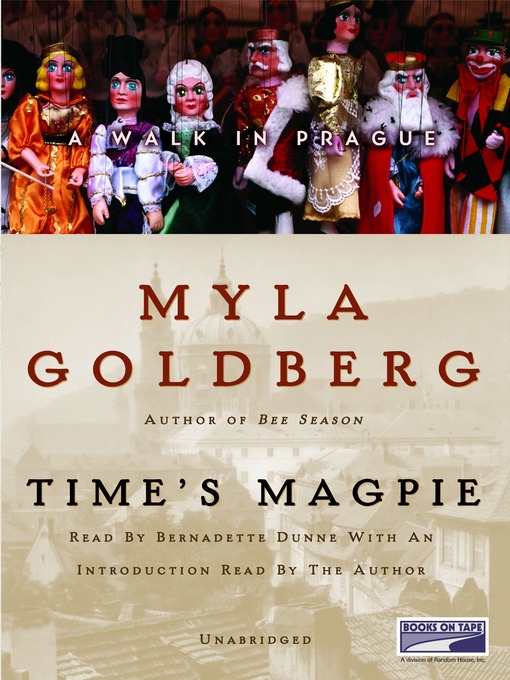
Time's Magpie: A Walk in Prague - Myla Goldberg

The Basics: Time's Magpie: A Walk in Prague, Myla Goldberg, 2004, 140 pages

How I found it: This book was featured at my library in the travel section. I spent some time in Prague while backpacking in Central Europe a few years ago, so I picked it up.

What's it about?: This book is a travel book, but it is not your usual travel book - it is not a guidebook or travel writing. Instead it is a series of little essays on the author's reflections as she returns for a visit ten years after she lived there. The essays are descriptions of neighbourhoods, explanations of the history of some areas, and a few anecdotes about her travels there.

Did I like it?: I enjoyed this book but I wasn't blown away by it. As I said, I've spent some time in Prague and like to think that I know a fair amount about it. However, there was almost nothing in Goldberg's book that I knew already: I guess it takes a former resident to really know the city. This book was unlike any I had ever read before, which I enjoyed. Goldberg writes well and in some passages I could clearly picture the sites she was describing.

Will you like it?: If you've been to Prague or want to go, this is a great alternative to a guidebook as it gives you a more interesting history behind the city, and also points out places of interest that are well off the usual tourist trail.

But don't take my word for it: The usual from Amazon, a brief review from another book blogger, and one from the New York Times.

Thursday, November 15, 2007

No Great Mischief - Alistair MacLeod

The Basics: No Great Mischief, Alistair MacLeod, 1999, 283 pages, hard cover

How I found it: I believe this was recommended to me by either Chapters or Amazon on one of those "if you liked _____, you'll also like _____" things. I don't really remember. I do, however, remember that I decided to pick it up since it was about Cape Breton, and because I don't think I've read enough male Canadian authors recently.

What's it about?: This novel is about the men of clan MacDonald on Cape Breton Island. The story is told through the eyes of Alexander MacDonald, somewhat of an outsider to the rest of the men due to his more privileged upbringing and his academic background. Despite being a bit more of a city boy, Alexander knows, as is mentioned throughout the book, that "blood is thicker than water". His last name, his red hair, and his home in Cape Breton all tie him to clan MacDonald and he is there for his kin whenever he is needed. The story follows Alexander's life from being orphaned at age three, to being a middle-aged orthodontist driving into Toronto every weekend to ensure that his alcoholic brother is still alive.

Did I like it?: This is one of the best books by a Canadian male author I have read in a long time. I was familiar with MacLeod's short stories and am surprised I had not read this book, his first novel, a lot sooner. He is a great writer and I really enjoyed this book. Usually I'm not a big fan of books with very few female characters, but I really liked this one. Cape Breton has a bit of mystique and legend about it, with its rugged landscape and Scottish heritage, and No Great Mischief only perpetuates it. Of course all the gaelic in the book helps.

Will you like it?: I know that not too many men read fiction, and even fewer actually make the effort to seek out good contemporary Canadian Literature (with a capital "L"). However, if you know such a man, please recommend this book to him - I guarantee he'll like it. No matter your gender, if you enjoy excellent Canadian lit, this is a must read.

But don't take my word for it: The usual and reader reviews from Amazon, a review from The Guardian, one from January Magazine, and finally one from the almost local Antigonish Review.

Thursday, November 08, 2007

An Embarrassment of Mangoes: A Caribbean Interlude - Ann Vanderhoof

The Basics: An Embarrassment of Mangoes: A Caribbean Interlude, Ann Vanderhoof, 2003, 305 pages, hard cover

How I found it: It was recommended on the lotus reads blog and since I like food and travel writing, it sounded like a good book.

What's it about?: Vanderhoof and her husband were typical Torontoians caught up in the bustle and deadlines of their jobs - in magazine publishing in their case. As amateur sailors, they decided to save up some money and take a couple years off to sail down to the Caribbean. This book chronicles their two year sojourn. Vanderhoof is an unabashed foodie so the book is filled with their culinary adventures in local cuisine, as well as her own recipes for replicating their meals.

Did I like it?: The beauty of this book is that Vanderhoof and her husband are just regular people with regular lives living out a dream that many of us have had. While I don't particularly enjoy boats, the idea of sailing around the Caribbean for a couple years does sound quite enticing. Vanderhoof has experience writing and it shows - what could have otherwise been just another travel book ends up being something a bit out of the ordinary. I enjoyed this book and read it in only a few days.

Will you like it?: If you've ever dreamed of just packing up and sailing away, this is a great book to read since Vanderhoof paints a great picture of the highs and lows of long distance sailing. She also makes a point of exploring and embracing the local culture, especially the food, in the places she visits and this book will tell you a lot about the Caribbean that you won't find in the tourist brochures.

But don't take my word for it: The usual industry blurbs and reader reviews from amazon, a review from Pop Matters, one from the Boston Globe, another from the book blog curled up, and the blog post from lotus reads that led to me to read the book in the first place.

Friday, October 26, 2007

Mouthing the Words - Camilla Gibb

The Basics: Mouthing the Words, Camilla Gibb, 1999, 238 pages, hardcover, winner of the Toronto Book award in 2000

How I found it: I read Gibb's excellent Sweetness in the Belly this summer and loved it, so I wanted to read more of Gibb's work.

What's it about?: Moving the Words is the life story of Thelma, a girl who grows up with in a dysfunctional and sexually abusive home. To help her cope with her difficult life, she has several imaginary friends that stay with her into adulthood. Thelma's story is told from her perspective and the reader gets an inside look into her thought process and the delusions behind her mental illness. As Thelma gets older, she manages to finally escape from her family to some degree and begins to study law. Despite the seriously depressing subject matter, Thelma's story is at times humorous and entertaining.

Did I like it?: Somehow, I loved this book and couldn't put it down. Generally I find that books about sexual abuse and mental illness end up being too depressing or cliched, but that is definitely not the case with this book. Gibb writes beautifully, and at times Thelma's delusional thoughts are almost like poetry. The plot manages to keep things interesting as well. Thelma's experiences and personality are very far removed from my life, or from anyone's that I know, but I still managed to emphasize with her situation.

Will you like it?: I highly recommend this book. It is well written, and is a great read. The dark subject matter could be a turn-off, but I think the black humour found in some parts will more than make up for any depressing bits.

But don't take my word for it: The usual industry blurbs and reader reviews from Amazon, a collection of favourable quotes from reviews on the author's website, and a review from someone named Marty Smith's personal site.

Wednesday, October 24, 2007

King of Bollywood: Shah Rukh Khan and the Seductive World of Indian Cinema - Anupama Chopra

The Basics: The King of Bollywood: Shah Rukh Khan and the Seductive World of Indian Cinema, Anupama Chopra, 2007, 250 pages, hardcover

How I found it: This book was mentioned by another book blogger, lotusreads so I thought I'd check it out. I grew up in the multi-cultural city of Vancouver, and often watched Bollywood music videos on TV, so I was already interested in Bollywood in general.

What's it about?: This is part biography of Bollywood superstar Shah Rukh Khan, and part history of Bollywood from its origins in the '20s to the present. It is written to cater to readers who have no working knowledge of Bollywood and its culture, so I guess it is primarily for a Western audience.

Did I like it?: I didn't particularly enjoy this book. While it wasn't bad, it just wasn't good either. It is written well, and organized well, but I'm not really sure who this book is for. If you are a fan of Shah Rukh, the book is probably too much of an overview and tells you things you already know. If you don't know much about Shah Rukh, as I did, you are presented with only an idealized picture of him. As well, it is unclear how the Bollywood history piece fits into a biography like this one.

Will you like it?: If you are interested in Bollywood, this might be a good read. However, I am sure there must be better books on the history of Indian cinema. If you are interested in learing about Bollywood, renting a film is probably a much more entertaining way to go about it.

But don't take my word for it: The usual industry blurbs from amazon, a review from the New York Times, and one from the Delhi based Hindustan Times.

Friday, October 19, 2007

The Other Side of the Bridge - Mary Lawson

The Basics: The Other Side of the Bridge, Mary Lawson, 2006, 359 pages, hardcover

How I found it: I was browsing the new Canadian fiction section at my local library and came across this book. I was given Lawson's first novel, Crow Lake, as a Christmas gift a few years ago. I wasn't enthralled by that book, but I decided to give Lawson another chance to wow me.

What's it about?: This novel takes place in a small town in northern Ontario. The story centers around the lives of Arthur Dunn and Ian Christopherson. Arthur is a generation older than Ian and is a farmer, while Ian is the son of the town doctor. The story revolves around how the two men interact, and their love of the same woman. Their respective family issues also play an important part. Arthur has a difficult relationship with his brother, while Ian has a difficult relationship with his mother. The lives of the two men, which could seem so disparate, are told in a careful parallel.

Did I like it?: I loved this book. I thought the plot was beautifully constructed. The way the lives of Arthur and Ian played off each other was fantastic. The character development was also very well done. Usually when I read a book with male protagonists I don't relate to them very well, but Lawson has done such a good job that I was able to empathize with both Ian and Arthur. I couldn't put this book down and was quite sad when it was over.

Will you like it?: I highly recommend this book. It's a great story with great characters and even a few plot twists to keep in interesting. The parallels between Arthur and Ian, and the title itself would make great discussions for a book group. Although this is a book I got from the library, I will most likely purchase a copy as I know I will want to read it again.

But don't take my word for it: The usual industry review snippets and reader reviews from Amazon, one from The Guardian, another from the Washington Post, one from the book loving website curled up, and finally one from the journal Canadian Literature.

Monday, October 15, 2007

Storm Glass - Jane Urquhart

The Basics: Storm Glass, Jane Urquhart, 1987, 127 pages, hard cover

How I found it: I was desperate for something new to read so I went on a binge reserving books at the library. I searched for a few of my favourite authors (Urquhart being one) to see if there were any of their works that I hadn't read. This was one of them.

What's it about?: This is a collection of short stories. Some of the stories are grouped together in sets with similar themes, such as the five stories under the "Five Wheelchairs" heading, and the seven stories under "Seven Confessions". Overall the stories have nothing to do with each other and take place in different time periods with different characters and tones.

Did I like it?: This is one of Urquhart's earlier work from the time when she was primarily publishing poetry and it shows. Like a lot of Margaret Atwood's early work, it is very angsty and self-consciously arty with confusing plot twists and purposely ungrammatical sentences. As a result, I found it a bit annoying and amateurish compared to her later works and didn't enjoy it as much as I have enjoyed her novels.

Will you like it?: I would only recommend this book to hard core Canadian Lit fans, otherwise, please, please, please go pick up The Whirlpool, The Underpainter, Map of Glass and especially the Stone Carvers. They are all phenomenal and much better that these short stories.

But don't take my word for it: The usual from Amazon and her wikipedia page are all I could find.

Wednesday, October 10, 2007

Geisha, A Life - Mineko Iwasaki

The Basics: Geisha, A Life, Mineko Iwasaki with Rande Brown, 2002, 297 page, paperback

How I found it: I have been fascinated with Japan and Japanese culture since high school. One of my favourite books is Arthur Golden's Memoirs of a Geisha, and I also really enjoyed Liza Dalby's Geisha. I did some searching at my local library to see if I could find some real, rather than fictionalized, memoirs of a geisha, and came up with this book.

What's it about?: This is Iwasaki's autobiography. Due to complicated family circumstances, she was adopted into a geisha family as a young child and school in the Japanese fine arts, especially dance. She excelled and as a teenager debuted as one of the top geisha in Japan. She tried to enact reforms in geisha society, but was unsuccessful so she chose to retire at age 29 at the height of her popularity.

Did I like it?: I really enjoyed this book. It is not as sensational as Memoirs of a Geisha, but that's okay since it seems so much more real. Iwasaki has lead a very interesting life. She also spends portions of her book explaining how geisha society works, which was educational. Unlike the protagonist in Memoirs of a Geisha, I didn't really identify with Iwasaki. I found a lot of the decisions she made quite strange. However, she is a strong, independent Japanese woman, which is a rarity and is commendable.

Will you like it?: If you are at all interested in geisha, this is a great book to read as a sort of counterpoint to Memoirs of a Geisha. That book is a better story, but this is real life, and there is something to be said for that.

But don't take my word for it: The usual info and reader reviews from Amazon, a review from the Asian Review of Books, a review from a westerner living in Japan, and one from the UK regional newspaper Echo.

Sunday, September 30, 2007

The Equations of Love - Ethel Wilson

The Basics: The Equations of Love, Ethel Wilson, 1952, 263 pages, paperback

How I found it: I've read some of Ethel Wilson's other books and enjoyed them. I was in line to check out books at my local public library and happened to see this one on the paperback rack. I had never heard of it, but picked it up on the spur of the moment anyway.

What's it about?: This is really two books in one; it is two novellas. "Tuesday and Wednesday" tells the story of two (important) days in the life of Myrtle and Mort Johnson. "Lilly's Story" follows a young woman who goes to incredible lengths to protect her daughter and give her the life she wished she had had. Both are about love, but in very different ways, which I suppose explains the title of the collection.

Did I like it?: Disappointingly, I didn't like either novella at all. They were well written, as is characteristic of Wilson's work, but they just didn't interest me. In particular, I found the protagonists in both works to be unlikeable and didn't relate to them at all. I found Myrtle to be a despicable person, and Mort to be a sad sack lazy guy. I found Lilly to be delusional to the point of feeling sorry for her. As usual hower, Greater Vancouver plays a part in the story, and Wilson's descriptions of the city and its surroundings in the earlier part of the 19th century were fascinating.

Will you like it?: I'm sad to say that this one is not recommended. I've said before the Ethel Wilson is possible the most underrated Canadian female fiction author, and it's true. However, this is not her finest work. Check out Swamp Angel first.

But don't take my word for it: The usual info from amazon and her wikipedia page are all I could find.