I read 54 books in 2007 - more than one a week apparently, which is not bad. I think the books I read this year are of a higher quality than the ones I read last year since I had a really hard time coming up with books to put on the "worst" lists. As is becoming my custom, here are my picks for best and worst of 2007:
Best Fiction:
The Other Side of the Bridge - Mary Lawson
(Runner-up: Treading Water - Anne DeGrace)
Best Non-Fiction:
The Secret Life of Lobsters - Trevor Corson
(Runner-up: The 100-Mile Diet - Alisa Smith and J.B. MacKinnon)
Worst Fiction:
Gossip Girl - Cecily von Ziegesar
(Runner-up: Strawberry Fields - Marina Lewycka)
Worst Non-Fiction:
Ultimate High: My Everest Odyssey - Goran Kropp
(Runner-up: The Ghost Map - Steven Johnson)
Monday, December 31, 2007


Thursday, December 27, 2007
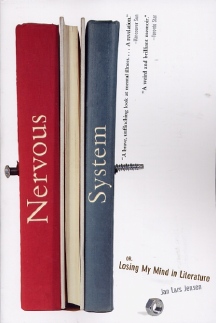
Nervous System - Jan L Jensen
 Disclaimer: The author of this book is a friend of mine, and therefore, my review is probably a little biased.
The Basics: Nervous System or Losing My Mind in Literature, Jan Lars Jensen, 2004, 273 pages, paperback
How I found it: As previously mentioned, the author is a friend of mine. I've known him for a few years and I finally got around to reading his book.
What's it about?: This book is a memoir about the author's experience with mental illness. As the publication date for his first book, Shiva 3000, drew nearer, Jensen slipped further and further into an episode of psychosis. He became convinced that the religious undertones of his science fiction novel would set off a chain of events that would result in a major global disaster. He stopped sleeping and became increasingly out of touch with reality. Jensen's psychosis culminated in a suicide attempt that landed him the psych ward of the local hospital. His book chronicles the portion of his life that led up to and followed his time in the hospital. He tells his story in a style that allows the reader to get inside his head and understand what he went through.
Did I like it?: I really enjoyed this book. It was like nothing I have ever read before. When we say that someone is 'crazy' I don't think we really know what that means. After reading Jensen's book I feel as though I have a better understanding. At the same time, now that I have a better understanding, I find the whole idea much more terrifying because I realize how easy it is to slip away from reality. Jensen also writes very well and has structured the book in a manner that is very engaging.
Will you like it?: If you know someone with mental illness (which you probably do), or you are interested in mental illness, I think this is a great book to read. It is well written, and presents a great counter-point to the mostly clinical information on mental illness usually given in the mainstream media because it really humanizes the experience.
But don't take my word for it: The usual collection of publisher-approved reviews and reader reviews from Amazon, a review from The Guardian, and a collection of reviews from the author's website.
Friday, December 21, 2007
Shadow of the Bear: Travels in Vanishing Wilderness - Brian Payton

The Basics: Shadow of the Bear: Travels in Vanishing Wilderness, Brian Payton, 2006, 304 pages, paperback
How I found it: I read an excellent article in the winter 2007 issue of Explore magazine by J.B. MacKinnon (c0-author of The 100-Mile Diet). The article, entitled "To Kill a Bear" mentioned a book by MacKinnon's friend Brian Payton, and it sounded fascinating so I picked it up.
What's it about?: Payton travels around the globe to visit the habitats of the world's eight remaining bear species. He explores the relationship between the bears and the people they live near, the cultural importance of the bears to those people, and the struggles facing each bear species. The book is part travel writing, part investigative journalism, and part bear biology and behaviour manual.
Did I like it?: I really loved this book. I learned a lot - for instance, I had no idea that there were bears in South America (the spectacled bear), India (sloth bears), and South East Asia (sun bears). I also really enjoyed the way Payton presented the book: it was a personal journey for him to learn about these bears and their threatened existence. However, Payton is often self-critical of his opinions and quick to realize that there are no easy solutions. I couldn't put it down, and in some ways wished it was longer.
Will you like it?: If you are at all a fan of non-fiction, I think this is a must-read. Payton writes well and is engaging. The book is divided into neat chapters - one for each bear species, making the book easy to read in chunks when you have time. But you'll probably want to read it all at once!
But don't take my word for it: The usual major media blurbs from Amazon, a review from Green Living Online, one from the Winnipeg Free Press on the Bear Matters BC website, another on Bear Matters BC, this one from the Vancouver Sun, and the author's website.
Thursday, December 20, 2007
The Swinging Bridge - Ramabai Espinet
 The Basics: The Swinging Bridge, Ramabai Espinet, 2003, 305 pages, paperback, Shortlisted for the Commonwealth Writers Prize, Best First Book (Canada and the Caribbean Region)
How I Found it: I really don't remember. I think it might have been recommended on the Halifax library website.
What's it about?: Mona, the protagonist, is a woman of Indian descent, who grew up in the Indian community in Trinidad, then moved to Canada with her family as a teenager. The novel takes place in Mona's 30s as she reflects on her childhood in Trinidad and her relationships with her family. Reconciling the events of the past and discussing them with her family, even though it is difficult, is especially important because her older brother is near death.
Did I like it?: I didn't love this book, but it was good. The author writes very well, and at times is almost poetic. She has a gift for description - she makes the reader feel that she is actually in Trinidad. Before reading this book I didn't really know anything about Trinidad, and the Indian community there, so I learned a lot.
But don't take my word for it: The usual industry and reader reviews from Amazon, a review from Seneca College Quarterly, some info on the author from Literature Alive (a Canadian-Caribbean Literature website), a review from Now Toronto, one from blog alice, and one from Canadian Literature, a quarterly journal.
Thursday, December 13, 2007
Gossip Girl - Cecily von Ziegesar
 The Basics: Gossip Girl, Cecily von Ziegesar, 2002, 199 pages, paperback
How I Found it: Like many people, I often find myself enjoying crap-tastic nighttime soap operas about people whose lives are far removed from mine (mostly because they live in California apparently). Anyway, the big buzz this fall was that the guy from The O.C. were now doing a Gossip Girl TV show. I liked the show (embarrassing to admit, I know), so I thought I would the original book from the series the show is based on.
What's it about?: For those unfamiliar with the premise, the Gossip Girl series is about a group of super-rich teenagers living on Manhattan's Upper East Side, going to private schools, getting drunk and high and spending their parents money. The plot of the first book in the series roughly covers the events of the first two episodes of the show (with quite a few minor differences). Basically, girl leaves town because she slept with best friend's boyfriend and doesn't want to tell her. Girl returns to town, chaos ensues. Also, boy has loved girl for a long time even though she doesn't know who he is, boy and girl meet, fall in love, live happily ever after (or at least until the next book I guess).
Did I like it?: This is teenage trash at its finest. The writing is clunky, the plot is vaguely ridiculous and the omnipotent narrator, "gossip girl", a blogger, is completely implausible. The book reads as if it is trying desperately to impress you with its sophisticated and rich characters. I was not impressed, however. I find the show much better written and better executed. It's not surprising that the book fees poorly put together - a quick glance at wikipedia reveals that the author published 8 of these books between 2002 and 2005 before having the remainder of the series ghost-written. There has also been criticism of the books because they seem to condone underage drinking, drug-use, and teenage sex. While those issues are all facts of everyday teenage life, I'm not sure that the way they are glamourized and idealized in the novel is right message to be sending young girls. These books are aimed at a teen and tween audience and I don't know if I think that is appropriate. However, other critics have said that they are just happy that kids are reading at all. It's sad I guess.
Will you like it?: Unless you are a 14 year old girl who wants to piss-off their conservative mom by secretly reading this book, I don't think it is worthwhile. However, spending an hour a week vegged out in front of the TV watching the television series is something I do recommend.
But don't take my word for it: Some info (including appropriate age groups) and reader reviews from Amazon (check out the 1 star reviews for some truth), a sugar-coated review from the teen site Girl Posse, and a New York Times article about the affect of books like this on tween fiction.
Monday, December 10, 2007
Voyageur: Across the Rocky Mountains in a Birch Bark Canoe - Robert Twigger
 The Basics: Voyageur: Across the Rocky Mountains in a Birch Bark Canoe, Robert Twigger, 2006, 390 pages, hard cover
How I found it: My Dad highly recommended this book so I requested it from the local library.
What's it about?: Twigger is a Brit with limited outdoor experience who attempted to replicate a journey that has not been repeated since Alexander MacKenzie did it in the 1700s: cross the Rocky Mountains by birch bark canoe. He spent a considerable sum having a birch bark canoe made for him in the traditional way and did a bit of paddling about on the small English rivers near his home in Oxford. Otherwise, he didn't do much preparation. His expedition stretched out over 3 consecutive summers, but I won't give away how far he got as it would take away from the experience of reading the book.
Did I like it?: I am not the most seasoned outdoorsperson I know, but I believe I am fairly knowledgeable. Therefore, books like this one get me a little aggravated. Twigger bumbles through the book, seeming to know close to nothing about canoeing (he is inexperienced in white water), trip planning (he agrees to take on trip partners he has just met, and has never camped or canoed with, he buys all of their food for one summer in a mad 30 minute rush in a grocery store in the last big town before the put-in), and even basic camping and survival skills (he brings huge amounts of extremely heavy gear, but has little first aid knowledge). Despite the aggravation, I found this book to be an okay read. A description of a journey of this magnitude could never be boring, and Twigger writes in a straight-forward, honest, and often self-deprecating style that I liked. However, I still feel that Twigger is one of those guys I would never ever want to share a campsite with, despite the fact that he fully owns up to his idiocy.
Would you like it?: If you are a fan of adventure travel literature, this book is one of the few written about trips in Canada, and its not a bad book. It's just not a great book. If you are more of an armchair traveler, than a hands-on one, the idiocy of many of Twigger's decisions may be lost on you, and you might like this book far more than I did.
But don't take my word for it: Some really basic info from Amazon, a review from the travel site Road Junky, a bunch of glowing reader reviews from the British Amazon site, a review from The Spectator, and one from The Guardian.
Friday, November 30, 2007
Strawberry Fields: Marina Lewycka
 The Basics: Strawberry Fields, Marina Lewycka, 2007, 291 pages, hard cover
How I found it: I read enjoyed Lewycka's previous novel, A Short History of Tractors in Ukranian, so I put myself on the waiting list at the library for this one.
What's it about?: This novel is about a group of strawberry pickers in England. They are migrant workers from Eastern Europe, Africa and Asia who are brought in illegally to pick strawberries. The book centres around their lives in the two decrepit trailers they live in near the fields, and the 'adventures' they have after they leave the strawberry fields. The book begins with the narrative shifting between the nine workers and their dog, but by the end of the book, it has come to focus on the two Ukranians, Irina and Andriy. It is a story about being in a strange land where you don't understand what is going on, it is about hardship and about friendship and about 'adventure'. Apparently, it is also supposed to be funny.
Did I like it?: I HATED this book. I have read books that are much worse than this one, but I feel I must give a much harsher critique of the this book because I really enjoyed Lewycka's work in the past, the book has recieved critical acclaim, and she was previously nominated for the Booker. The idea of this book is a good one, but it was so poorly executed I just couldn't believe it. The idea of telling a story from such a wide array of perspectives is interesting, but it obviously was too much work since Lewycka had to keep inventing reasons for some of the characters to leave so that she could focus on less of them. The plot of the book was also terrible. I have watched some nighttime soaps that had better thought out plots. Lewycka seems to think that sending bumbling immigrants careering across England in search of some destination at random would be a recipe for plot success. Perhaps this book is meant to be character-driven and then the plot doesn't matter so much. Except that there is so much filler going on that we don't get to focus on the characters that much, and the flash-back scenes to Andriy and Irina's pasts just seem contrived. The book is also supposed to be funny. Overall, I found it quite sad and depressing and felt sorry for the characters. I think I was supposed to laugh at them, since there wasn't anything to laugh with them about. I didn't feel like laughing at them though, since they were so sad and so stereotyped. All in all, I hated reading this book and couldn't wait for it to be over. (However, I will say that the only redeeming part was that sometimes the dog's narrative was funny when it wasn't completely annoying.)
Will you like it?: This one is not recommended. According to some reviews I've read, apparently British people find this book funny, since they find immigrant stereotypes, particularly the bumbling type, to be hilarious. If you find that hilarious, then by all means read this book. Otherwise, stay well away and pick up Lewycka's other book, also about Ukranian immigrants instead. It is genuinely funny and well written, two qualities this book definitely lacks.
But don't take my word for it: The usual and reader reviews from Amazon, a review from Toronto's Now Magazine, one that says what I was thinking, only in a nicer tone, from the New York Times, another one from the LA Times, and one from the UK's The Guardian (where the book was published as Two Caravans).
Monday, November 19, 2007
Time's Magpie: A Walk in Prague - Myla Goldberg
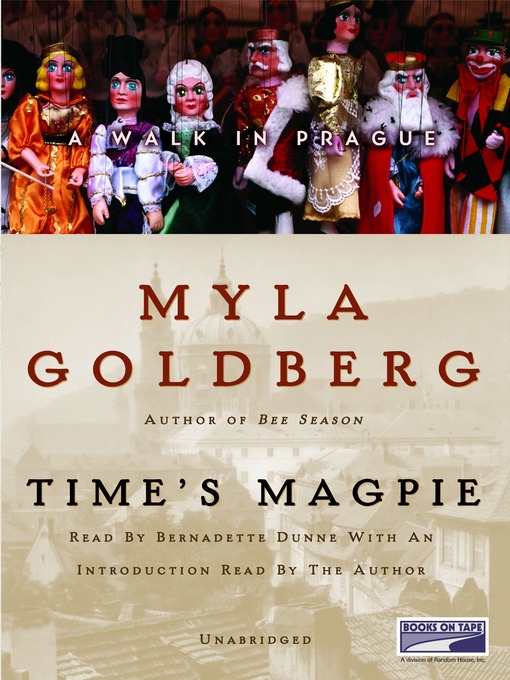 The Basics: Time's Magpie: A Walk in Prague, Myla Goldberg, 2004, 140 pages
How I found it: This book was featured at my library in the travel section. I spent some time in Prague while backpacking in Central Europe a few years ago, so I picked it up.
What's it about?: This book is a travel book, but it is not your usual travel book - it is not a guidebook or travel writing. Instead it is a series of little essays on the author's reflections as she returns for a visit ten years after she lived there. The essays are descriptions of neighbourhoods, explanations of the history of some areas, and a few anecdotes about her travels there.
Did I like it?: I enjoyed this book but I wasn't blown away by it. As I said, I've spent some time in Prague and like to think that I know a fair amount about it. However, there was almost nothing in Goldberg's book that I knew already: I guess it takes a former resident to really know the city. This book was unlike any I had ever read before, which I enjoyed. Goldberg writes well and in some passages I could clearly picture the sites she was describing.
Will you like it?: If you've been to Prague or want to go, this is a great alternative to a guidebook as it gives you a more interesting history behind the city, and also points out places of interest that are well off the usual tourist trail.
But don't take my word for it: The usual from Amazon, a brief review from another book blogger, and one from the New York Times.
Thursday, November 15, 2007
No Great Mischief - Alistair MacLeod
 The Basics: No Great Mischief, Alistair MacLeod, 1999, 283 pages, hard cover
How I found it: I believe this was recommended to me by either Chapters or Amazon on one of those "if you liked _____, you'll also like _____" things. I don't really remember. I do, however, remember that I decided to pick it up since it was about Cape Breton, and because I don't think I've read enough male Canadian authors recently.
What's it about?: This novel is about the men of clan MacDonald on Cape Breton Island. The story is told through the eyes of Alexander MacDonald, somewhat of an outsider to the rest of the men due to his more privileged upbringing and his academic background. Despite being a bit more of a city boy, Alexander knows, as is mentioned throughout the book, that "blood is thicker than water". His last name, his red hair, and his home in Cape Breton all tie him to clan MacDonald and he is there for his kin whenever he is needed. The story follows Alexander's life from being orphaned at age three, to being a middle-aged orthodontist driving into Toronto every weekend to ensure that his alcoholic brother is still alive.
Did I like it?: This is one of the best books by a Canadian male author I have read in a long time. I was familiar with MacLeod's short stories and am surprised I had not read this book, his first novel, a lot sooner. He is a great writer and I really enjoyed this book. Usually I'm not a big fan of books with very few female characters, but I really liked this one. Cape Breton has a bit of mystique and legend about it, with its rugged landscape and Scottish heritage, and No Great Mischief only perpetuates it. Of course all the gaelic in the book helps.
Will you like it?: I know that not too many men read fiction, and even fewer actually make the effort to seek out good contemporary Canadian Literature (with a capital "L"). However, if you know such a man, please recommend this book to him - I guarantee he'll like it. No matter your gender, if you enjoy excellent Canadian lit, this is a must read.
But don't take my word for it: The usual and reader reviews from Amazon, a review from The Guardian, one from January Magazine, and finally one from the almost local Antigonish Review.
Thursday, November 08, 2007
An Embarrassment of Mangoes: A Caribbean Interlude - Ann Vanderhoof
 The Basics: An Embarrassment of Mangoes: A Caribbean Interlude, Ann Vanderhoof, 2003, 305 pages, hard cover
How I found it: It was recommended on the lotus reads blog and since I like food and travel writing, it sounded like a good book.
What's it about?: Vanderhoof and her husband were typical Torontoians caught up in the bustle and deadlines of their jobs - in magazine publishing in their case. As amateur sailors, they decided to save up some money and take a couple years off to sail down to the Caribbean. This book chronicles their two year sojourn. Vanderhoof is an unabashed foodie so the book is filled with their culinary adventures in local cuisine, as well as her own recipes for replicating their meals.
Did I like it?: The beauty of this book is that Vanderhoof and her husband are just regular people with regular lives living out a dream that many of us have had. While I don't particularly enjoy boats, the idea of sailing around the Caribbean for a couple years does sound quite enticing. Vanderhoof has experience writing and it shows - what could have otherwise been just another travel book ends up being something a bit out of the ordinary. I enjoyed this book and read it in only a few days.
Will you like it?: If you've ever dreamed of just packing up and sailing away, this is a great book to read since Vanderhoof paints a great picture of the highs and lows of long distance sailing. She also makes a point of exploring and embracing the local culture, especially the food, in the places she visits and this book will tell you a lot about the Caribbean that you won't find in the tourist brochures.
But don't take my word for it: The usual industry blurbs and reader reviews from amazon, a review from Pop Matters, one from the Boston Globe, another from the book blog curled up, and the blog post from lotus reads that led to me to read the book in the first place.
Subscribe to:
Posts (Atom)