Thursday, February 28, 2008

The Almost Moon - Alice Sebold

The Basics: The Almost Moon, Alice Sebold, 2007, 291 pages, hardcover

How I found it: I believe this was on some bestseller lists last year. I also read Sebold's previous book, The Lovely Bones, a few years ago. I didn't love it, but since it was okay I thought I would read her next one.

What's it about?: This novel is about a woman who kills her elderly mother rather than send her to a 'home'. She spends the rest of the book trying to cover up the murder and reliving her terrible childhood and her relationship with her mother.

Did I like it?: I hated this book. While it was competently written, the plot was not engaging. Instead it was just grim and tiresome. The protagonist was not likable, despite the fact that Sebold obviously wanted the reader to sympathize with her. Although the book itself is not scary, I found myself having nightmares while I was reading it, which is never a good sign. I couldn't wait to finish reading this so I didn't have to think about its deplorable characters anymore.

Will you like it?: I suppose it is obvious that I don't recommend this book. Unless you enjoy morbidity and relate to people who murder their parents, stay away. Sebold's The Lovely Bones was also a bit morbid, so perhaps stay away from Sebold altogether.

But don't take my word for it: The usual blurbs (one of which actually calls the book disappointing) and reader reviews (which are almost all negative) from Amazon, a review from Mostly Fiction, a more positive one from the San Fransisco Chronicle, one from New York's The Village Voice, another from The New York Times, and one from PopMatters.com.

Sunday, February 17, 2008

Turtle Valley - Gail Anderson-Dargatz

The Basics: Turtle Valley, Gail Anderson-Dargatz, 2007, 292 pages, hardcover

How I found it: I can't really remember how I read about it, but I know I must have been interested in reading it because it is by a female Canadian author, and it is about a region I am familiar with

What's it about?: This novel tells the story of a woman who must return to her aging parents rural home to help them pack up in the face of a looming forest fire. The home is located in Turtle Valley, which is near Salmon Arm, BC in the Shuswap Lake area. The protagonist, Kat, is reminded through the events of the story, of her complicated past, and the difficulties that are to come, such as her parents declining health and the aftermath of her young husband's stroke. Kat also discovers things about her parents and grandparents, who lived in their historic farmhouse, as she packs up the house in anticipation of its destruction at the hands of the fire. It's a complicated story about family, happiness, and self-discovery.

Did I like it?: I really enjoyed this book, and I actually couldn't put it down. I've never read a book by Anderson-Dargatz before, and I have no idea why. I don't think I had even heard of her before this, which is surprising. She writes beautifully and has a very engaging style. Her characters are likable and well-developed. The plot of this novel is also quite well developed, which several story-lines that all weave together well and are brought together in the lives of the family.

Will you like it?: I highly recommend this book. It's a great story and is well-written. I couldn't put it down and you probably won't want to either. My only disclaimer is that like most things I like, it's a bit of a woman's book and probably great for bookclubs.

But don't take my word for it: The usual publisher-approved blurbs from Amazon, a review from Vancouver's alternative weekly The Georgia Straight, one from January Magazine, info about the book from the author's website, and an excerpt of the book printed in Canadian Living Magazine,

Wednesday, February 13, 2008

Lawyers Gone Bad: Money, Sex and Madness in Canada's Legal Profession - Philip Slayton

The Basics: Lawyers Gone Bad: Money, Sex and Madness in Canada's Legal Profession, Philip Slayton, 2007, 294 pages, hardcover

How I found it: This book was in the Canadian news a lot in the summer of 2007 when it came out. Most notably, it inspired a Maclean's Magazine cover story entitled "Lawyers are Rats" that inflamed the Canadian legal community (see here for a summary). In the fall, I went (out of curiosity) to a talk that Slayton gave about his opinions on the reform of regulation of the legal profession. As a result, I was curious to see what all the fuss was about.

What's it about?: Each of this book's chapters details the crimes and indiscretions of a particular lawyer gone bad. The wrongs committed by these people include money laundering, stealing money, sex with clients, and all kinds of other dirty dealings. Slayton asserts that these cases are special because they often were committed by lawyers who were otherwise successful in the profession. At the end of the book, Slatyon closes with a few pages containing his thoughts on how the legal profession might be reformed, including the problems with the self-governance system.

Did I like it?: This book was interesting in the same way Jerry Springer or a highway car wreck is interesting: other people's problems are on full display in all their sensationalistic glory. Overall, I didn't really like the book that much. Slayton was mostly into criticizing the people he profiled for how they had royally screwed up. However, the real problem with the legal profession, in my opinion, is that lawyers don't screw up royally very often - instead they just pad their billings here and there, fail to report things to the law society - minor stuff. When I saw Slayton speak he emphasized these little screw ups as the real problem, and spoke at length about how he left the self-governing provincial bar societies were at the root of the problem. However, that argument is barely a footnote in his book, probably because if it were more prominent, he never would have got the media coverage he did.

Will you like it?: If you are truly looking for some sensational stories about 'lawyers gone bad' then you might find this book entertaining as you make yourself feel better by reading about someone who really screwed up. However, if you just read this book to see what all the hype was about, you might be a bit disappointed. And if you are involved in the legal profession, it is likely that you are boycotting this book altogether due to the media backlash against lawyers that it generated.

But don't take my word for it: The usual publisher-approved blurbs from Amazon, a review from Vancouver's alternative weekly newspaper, The Georgia Strait, one from The Toronto Star, and a collection of positive reviews from the author's web page.

Wednesday, February 06, 2008

In Defense of Food: An Eater's Manifesto - Michael Pollan

The Basics: In Defense of Food: An Eater's Manifesto, Michael Pollan, 2008, 244 pages, hardcover

How I found it: I read Pollan's last book, The Omnivore's Dilemma, a few years ago and loved it. In fact, I even named it best non-fiction of 2006. In The Omnivore's Dilemma, Pollan explores where our food comes from, but he doesn't really comment on what we should eat. I wanted to read In Defense of Food since it was promoted as commenting on what we should eat.

What's it about?: The sub-tile of this book is "An Eater's Manifesto", and this book really is a manifesto. Pollan attempts to convince us of his argument, then urges us to lead a quiet revolution through our food choices. The mantra for the book is "Eat Food. Not Too Much. Mostly Plants". Pollan begins by explaining that by "food" he means unprocessed natural foods, not the overly-processed, additive-addled pseudo foods that dominate our grocery stores, and that our grandparents likely would not have recognized as food. He examines the declining nutritional value of our food and challenges the science behind modern notions of what is nutritional. Overall, he advocates a return to whole, unprocessed foods that are better for us, and taste better.

Did I like it?: I enjoyed this book a bit because to some degree, I agree with Pollan: I'd like to eat more whole, unprocessed foods. I have a variety of minor stomach ailments, and find that I feel better when I eat unprocessed foods and cook from scratch. It was nice to see a pseudo-scientific and definitely logical explanation for why those unprocessed foods make me feel better. Some people may take issue with Pollan's condemnation of nutritional science, but I found it quite convincing.

Will you like it?: If you have read The Omnivores Dilemma, this is a good follow-up book. As well, if like many people, you are becoming interested in local eating and whole foods, this is a great book to read. As well, if you are the kind of person that has read a bunch of diet books, or tried a variety of diets, you might find the nutrition section of the book interesting since it debunks (or attempts to) a lot of the traditional diet literature.

But don't take my word for it: The usual publishers blurbs and reader reviews from Amazon, a review from the International Herald Tribune, one from the Wise Bread website, another from the London Times, and one from the LA Times.

Thursday, January 31, 2008

Divisadero - Michael Ondaatje

The Basics: Divisadero, Michael Ondaatje, 2007, 273 pages, hardcover, winner of the 2007 Governor General's Literary Award, nominated for the Giller in 2007

How I found it: I have read much of Ondaatje's work since he is one of the quintessential contemporary Canadian authors. This is his first book in seven years and was critically acclaimed so I thought I would give it a read.

What's it about?: This book is less of a novel and more like three interconnected novellas. The novel begins with the introduction of the characters that appear in each of the novellas: Anna Claire and Cooper. None of them are related by blood, but they have been raised as siblings on a Northern California ranch. Anna narrates the opening chapter will memories of their idyllic childhood and the startling events that ripped their family apart. The siblings drift apart and the remainder of the novel tells the stories of their disparate lives. Anna becomes a writer and historian studying a little known French poet. She travels to France to stay in the chateau that was once his, and the novel begins to explore the lives of the poet and his contemporaries in the chateau.

Did I like it?: This book was beautifully written, and as usual Ondaatje proved his chameleon-like quality to take on any perspective convincingly. However, I didn't really like this book very much. The inter-related quality of the storylines meant that the reader never really gets to hear the full story for some of the characters. As well, the inter-relatedness is not always immediately apparent: you turn the page and are suddenly introduced to a whole new set of characters who you only realize 20 pages later are meant to be related to the original characters in some way.

Will you like it?: Divisdero is really "literature" - casual readers may not enjoy it. I can see why it won all sorts of awards since it is a very well crafted work. However, from a pure reading enjoyment perspective, it wasn't very interesting and was not that pleasant to read. I recommend some of Ondaatje's other works over this one, unless you are really into literature.,

But don't take my word for it: The usual publisher's blurbs and reader reviews from Amazon, a review from Quill and Quire, one from the book blog So Misguided, another from the International Herald Tribune, and another review from another book blogger, The Dewey Divas and the Dudes.

Wednesday, January 23, 2008

Wind Tails - Anne De Grace

The Basics: Wind Tails, Anne Degrace, 2007, 302 pages, hardcover

How I Found it: I was given Degrace's previous book, Treading Water, as a gift the Christmas before last and absolutely loved it. When I saw that she was releasing a new novel I immediately put myself on the waiting list at the library.

What's it about?: The lives of several people from different walks of life all serendipitiously come together at an out of the way roadside diner one day in 1977. The premise is that the wind has blown these people towards the diner. The book is more a study in characters than a novel. Some characters, such the young and troubled Jo, are recurring, while others drift into the cafe, tell their vignette, and leave.

Did I like it?: This was an enjoyable read, but I didn't love it. I think Degrace is a great writer and I really like her style. However, I found this book a little disjointed since there were so many characters to keep track of. Eventually it became clear which characters were recurring and therefore important, and which ones I could forget about. I don't give it away, but I thought the ending was both obvious and contrived. It's also worth mentioning that like Treading Water, Wind Tails has a fabulous cover.

Will you like it?: If you are looking for under-appreciated Canadian authors, I think Degrace would be a great one to read. However, I think you should start with Treading Water, rather than this book. Wind Tails is enjoyable, it's just that there are quite a few contemporary Canadian novels that are a bit better.

But don't take my word for it: The usual publisher's blurbs and reader reviews from Amazon, a collection of reviews on the author's website, and an in-progress review from the blog In Over My Head.

Friday, January 18, 2008

Late Nights On Air - Elizabeth Hay

The Basics: Late Nights on Air, Elizabeth Hay, 2007, 363 pages, hardcover, winner of the 2007 Giller Prize

How I found it: I decided to read this book when the Giller shortlist came out. However, I was on the waiting list at the library so long that Hay's book had won by the time I read it.

What's it about?: This novel follows the lives of several staff members at the Yellowknife CBC radio station in 1975. The story begins as an ensemble piece and slowly explores the lives of quite a few characters. However, by the end of the book, the plot focuses on Harry, the grizzled veteran broadcaster at the tail-end of his career, and Gwen, the young self-conscious rookie. Late Nights on Air is concentrated around the social interactions of the characters, and their resulting insecurities. All of this is set against a backdrop of the Berger Inquiry into the (at the time) proposed Mackenzie Valley Pipeline.

Did I like it?: I really enjoyed this book and was surprised that I had never read any of Hay's work before. The novel was very character driven, which was good, since the characters were very well written and three-dimensional. The pace of the book was a little slow, but somehow I wasn't bothered by that. I have done some research on current issues to do with the Mackenzie Valley Pipeline, so it was also interesting to see a dramatization of the issues surrounding the decision to go forward with the pipeline in the areas that would be most affected by it. I am not completely in love with this book, but I agree that it is well written and a great story, so I think it is well-deserving of its Giller win.

Will you like it?: I you like good contemporary Canadian literature this is required reading. I especially recommend this book because it tackles important issues not usually seen in Canadian fiction: the realities of living in the urban North, and the environment.

But don't take my word for it: The usual publisher-approved reviews and reader reviews from Amazon, a review from The Walrus, one from Vancouver's The Georgia Straight, another from The Tyee, and finally one from the blog Kailana's Written Word.

Saturday, January 12, 2008

Servants of the Fish: A Portrait of Newfoundland After the Great Cod Collapse - Myron Arms

The Basics: Servants of the Fish: A Portrait of Newfoundland After the Great Cod Collapse, Myron Arms, 2004, 242 pages, hardcover

How I found it: I found it in the featured local non-fiction section of the Halifax Public Library. I travelled around Newfoundland a few summers ago so this book looked interesting.

What's it about?: Arms had sailed up from his home port in the Eastern United States to Newfoundland every summer for several years before the closure of the cod fishery. This book details his circumnavigation of the island by sailboat several years after the cod fishery was closed. He stops in at some of the same small fishing villages and outports and talks to old friends from previous trips. His aim is to understand and document the human face of the cod collapse.

Did I like it?: I found this book fairly interesting. As a Western Canadian, I don't really know too much about the cod fishery, except that there used to be tons of cod and now there are none. I didn't really understand the effect that the collapse of cod stocks had had on Newfoundland until I read Arms' book. While the book was interesting as a study on the effects of the cod fishery, and as a sailing travelogue, I have read much better books in both veins (namely The Secret Life of Lobsters, and An Embarrassment of Mangoes).

Will you like it?: For pure reading pleasure, I recommend either of the two books above over Arms' book, but if you are interested in life in rural Newfoundland, I do recommend this book.

But don't take my word for it: Some reader reviews from the American Amazon, and the author's website are all I could find.

Sunday, January 06, 2008

A Spot of Bother - Mark Haddon

The Basics: A Spot of Bother, Mark Haddon, 2006, 354 pages, hardcover

How I found it: I really enjoyed Haddon's The Curious Incident of the Dog in the Night-Time and thought I should read his most recent novel.

What's it about?: This novel follows the members of a dysfunctional and oh-so-English family as they prepare for the daughter's upcoming wedding. The "spot of bother" is a mysterious rash on the retired father's hip that he becomes convinced is cancer. As their patriarch, George, slips into paranoia, depression and anxiety, Jean, the mother, Katie, the newly-engaged single mom, and Jamie, the unlucky in love gay son, struggle to cope with this change in their lives, as well as their own problems.

Did I like it?: From reading the description above would you believe that this book is supposed to be a comedy? In a lot of ways, this book is filled with typical English humour about usually unfunny subjects. The humour is supposed to be a counterpoint to the strife facing this family, but I mostly found the book sad, rather than funny. The book is told from the perspectives of all four members of the family and while I really enjoyed Jamie's portions, I found Katie and Jean's portions quite boring. George, the newly "crazy" dad's narratives were actually frightening to me as I witnessed first hand his descent into madness and his family's powerlessness to stop it. Compared to The Curious Incident, which I really loved, I didn't really enjoy this book.

Will you like it?: If you are a true fan of English black comedy, you might like this book. However, if you've never read any Haddon before, I suggest you start with The Curious Incident since A Spot of Bother is far inferior.

But don't take my word for it: The usual publisher-approved reviews and reader reviews from Amazon, a review from the New York Times, another from The Guardian, one from PopMatters, and finally one from the Literary Feline blog.

Thursday, January 03, 2008

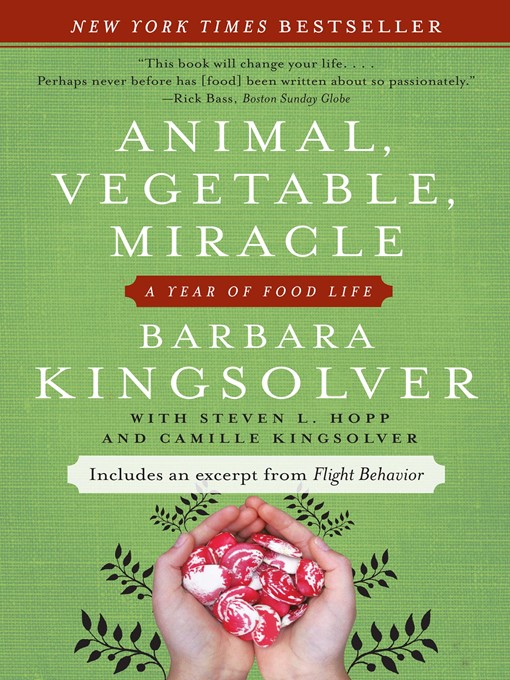
Animal, Vegetable, Miracle: A Year of Food Life - Barbara Kingsolver

The Basics: Animal, Vegetable, Miracle: A Year of Food Life, Barbara Kingsolver with Steven L. Hopp and Camille Kingsolver, 2007, 370 pages, hardcover

How I found it: This book got a bit of buzz this summer around the same time that The 100-Mile Diet came out. I decided to read Kingsolver's book as well since it also sounded interesting.

What's it about?: Kingsolver is an acclaimed novelist. She was living in Arizona with her husband and two girls when she decided that they should move to the family farm in Virginia and attempt to eat off the land as much as possible. The book chronicles their first year on the farm, including their efforts to grow fruits and vegetables, raise poultry, and make their own cheese and sausage. Kingsolver and her family were experienced gardeners before they began their experiment, and overall, it was a success. However, the book is more about a family rediscovering what it is like to live in a close-knit community and cooking together. The book also contains interludes from Kingsolver's husband, Steven Hopp, about the politics of farming and food, and some brief sections from her college-age daughter Camille on nutrition, cooking techniques and recipes.

Did I like it?: I didn't enjoy this book as much as I would have liked. Overall, I found that it was a cross between The 100-Mile Diet and The Omnivore's Dilemma, both of which I like more. However, it was fairly enjoyable and I felt newly inspired to grow my own food, or at least support the local farmers market. I even took Kingsolver's advice about how to make your own cheese - I checked out a book on home cheesemaking from the library and made some myself! I did find that the book was a bit preachy at times and was more about returning to a pastoral, small farming community way of life than it was about environmentalism. Not my favourite, but still excellent reading for those at all interested in food politics.

Will you like it?: Kingsolver writes well and doesn't idealize farm life - she tells it like it is, and is clear that despite the hard work, she loves her life on the farm. For pure reading enjoyment, I would probably recommend The 100-Mile Diet over this book, but for practical tips on how to really eat local, Animal, Vegetable, Miracle is probably better.

But don't take my word for it: The usual publisher-sanctioned reviews and reader reviews from Amazon, a review from the International Herald Tribune, one from Treehugger, an environmentalist website, another from Heavy Petal, a gardening blog, and the author's website.